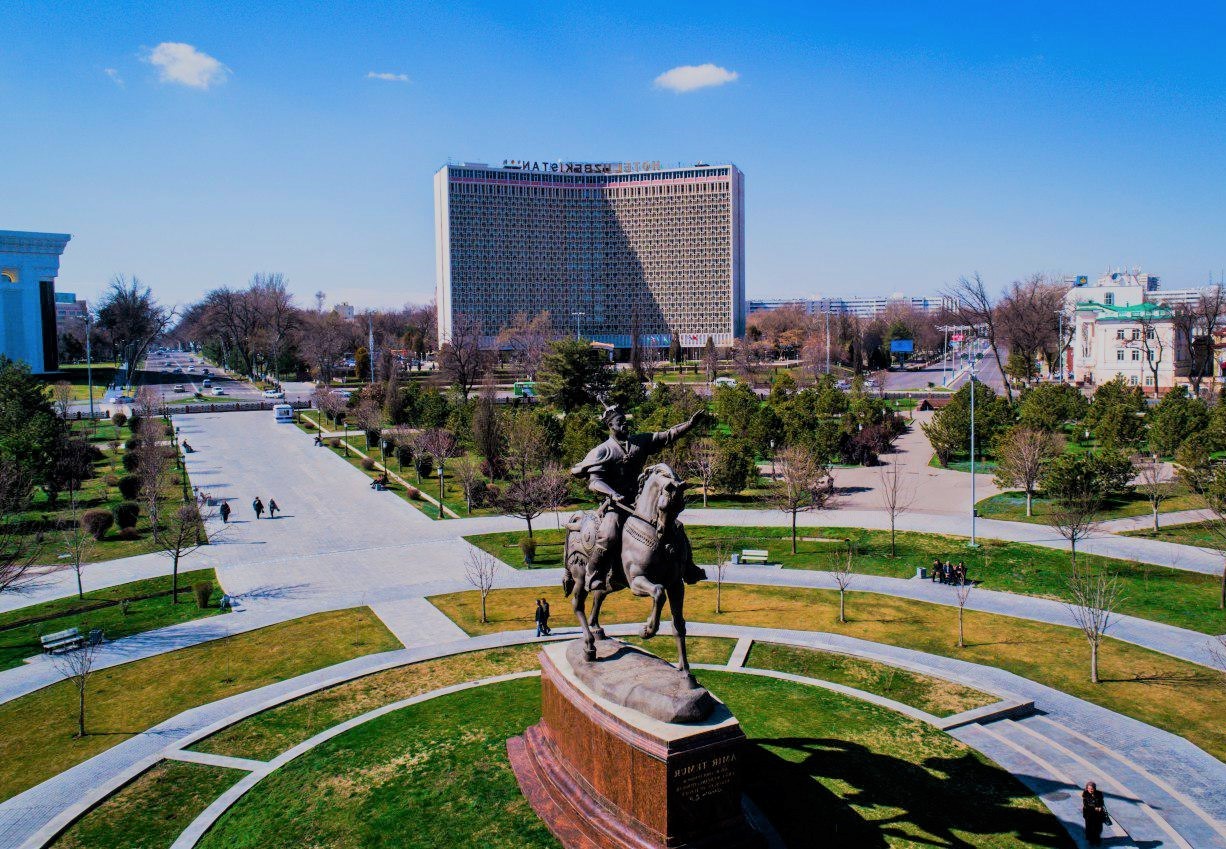
Amir Timur Square is a square with a small park in the central part of Tashkent in Uzbekistan. The history of the square began in the 2nd half of the XIX century, when the Turkestan region, later called the Turkestan General Government, was incorporated into the Russian Empire. Tashkent became the residence of the Russian governors-general. In 60-80-ies XIX century a park was laid out in the city centre, around which female and male gymnasiums, a state bank and a teachers’ seminary were built. The building of the girls’ grammar school now houses the Tashkent Institute of Law. The complex of historical buildings around the square has been carefully preserved. The church of St. Alexander Nevsky at the teachers’ seminary, built in 1898 by the architect A. Benua, has not been preserved.
After the death of the Governor General Konstantin Kaufman, his grave was located in the park and the square was called Konstantinovsky for a longtime. In 1913, with the help of donations, a multi-figure monument with a double-headed eagle and the inscription: “For Konstantin Petrovich von Kaufman and his troops who conquered Central Asia” was erected in the centre of the park. The monument was destroyed after the 1917 revolution and the plinth had a rich history. In the Soviet period there were many monuments: the banner and cannons, the hammer and sickle, the column with the Arabic script, Lenin, Stalin, a stele with the programme of the CPSU, Karl Marx. And the park, which for a short time was a public garden named after Maria Spiridonova, was called the Public Garden of the Revolution. The park was used for rallies in different years: the Communist Party in the 20- 30-ies, and from the 60-ies - gatherings of Crimean Tatars who demanded to return to Crimea after the deportation. From the 60- XX century a restaurant and an ice cream parlour opened here, the “golden youth” began to gather. The square became a popular place for meetings and recreation.